
Imagine you are 8 years old again, and you are mesmerized by the colorful game you are playing on your mom’s phone. The bright colors, the fun characters — you need more. Each level you win plays a little “cha-ching” sound that’s music to your ears.
Then you suddenly get a message: “Out of lives, pay just $0.99 cents for more!”
With all the online scams swarming the internet, these seemingly harmless advertisements in mobile games appear to be no big deal.
However, these microtransactions, in-game purchases within mobile games and other online games, draw in their targets through brightly colored facades and low prices. Even worse, many of their targets are not knowledgeable adults. As of 2024, it was estimated that more than 80% of all U.S. children aged 5-18 played video games, making them the prime target for in-app purchases (Consumer Financial Protection Bureau, 2024). More than 50 million kids’ minds are being manipulated by video games’ persuasive tactics similar to those used in casinos. As of 2025, teens aged 13-17 accounted for 16% of the mobile gaming base, with their average daily screentime reaching 96 minutes (Lee, 2025). With the younger population’s internet usage only increasing over the years, with more and more ways to draw them and their parents’ wallets in, this hidden economic plague will lead consumers down the path of significant cumulative spending and possible debt.
What are Microtransactions? What are their Effects?
When scouring the app store for games to purchase, it seems innocent enough to simply click the “get” button and have a new free game to play. This power is easily accessible to any young mind with their parent’s phone, or even their own device. Reports show that 60% of kids have access to an iPad or tablet-like device by the age of 4 (Kappes, 2025). However, once this seemingly free game is purchased, the pop-ups come in: power-ups, costumes, in-game currency, all at low prices that eventually add up, sometimes in the form of monthly subscriptions. All these purchases then continue to mount, and by the time the parent or guardian even gets a chance to notice, they already face large charges on their credit card.
This freemium strategy, offering free games with premium purchases, takes advantage of the phenomenon referred to as impulse buying. This is the idea that the player may just want one more power-up or even just the chance to play for five more minutes, to the point where they will mindlessly tap to keep spending.
However, these impulse purchases add up. Studies have found there to be associations between microtransactions and gambling problems, which can enable even more harmful spending that eventually adds up. A study found that in-game purchases of loot boxes — purchasable randomized reward mechanisms similar to slot machines — profited primarily from moderate- and high-risk gamblers, with spending patterns mirroring those observed in gambling (Close et al., 2021).
This study also highlighted other stories of young people spending tens of thousands of dollars on in-game purchases, with many even seeking treatment for “internet gaming disorder” due to the large debts they have accumulated from microtransactions.
Thus, this economic strategy is very similar to that used by gamblers trying to make a quick buck in casinos. In this case, however, the monetary prizes are not real, and many of the consumers’ minds are not fully developed. The minds of children and adolescents do not have the same development of their frontal cortex — which controls reasoning — as adults, and they are therefore more susceptible to impulse buying (American Academy of Child & Adolescent Psychiatry, 2017). After all, the minimum age to legally gamble in many states of the United States is 18 due to this susceptibility, so it would be just as harmful for youth to have access to video game gambling through microtransactions.
If Microtransactions are just Glorified Gambling, What’s the Big Deal?
Colorful mobile games such as Angry Birds and Candy Crush will rake in $75 billion from in-game purchases by the end of the year (Gibson et al., 2023). Spending on these microtransactions has increased yearly and is projected to increase even further.
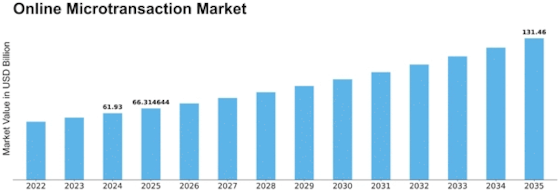
Dhapte, A. (2025, October). Online Microtransaction Market. marketresearchfuture.com.
The world is developing in a direction that enables young children to have greater access to the type of technology that exposes them to microtransactions. Thus, society needs to focus on not just the developmental and social effects of video games but also the economic effects, with addictive games taking control over people’s spending and habits. The effects will become more significant over time as the microtransaction market continues to grow, which can especially cause worry to individual consumers.
As technology continues to develop, with advertisements even able to target specific interests and individuals, we must consider its effects on the economy and the types of purchases we make as a society (Mizes, 2025). With the purchasing power that microtransactions and other online services provide at our fingertips, it is only a matter of time before addictive overspending goes too far, especially on these fictional products that can be summed up to a bunch of pixels.
References
American Academy of Child & Adolescent Psychiatry (2017, September). Teen Brain: Behavior, Problem Solving, and Decision Making. AACAP. https://www.aacap.org/AACAP/Families_and_Youth/Facts_for_Families/FFF-Guide/The-Teen-Brain-Behavior-Problem-Solving-and-Decision-Making-095.aspx
Clement, J. (2025, June 26). Consumer spending on in-game purchases worldwide from 2020 to 2025. Statista. https://www.statista.com/statistics/558952/in-game-consumer-spending-worldwide/
Close, J., Spicer, S.G., Nicklin, L.L., Uther, M., Lloyd, J., Lloyd, H. (2021, June). Secondary analysis of loot box data: Are high-spending “whales” wealthy gamers or problem gamblers? ScienceDirect. https://www.sciencedirect.com/science/article/abs/pii/S0306460321000368
Consumer Financial Protection Bureau (2024, August 28). Consumer Advisory: Video Games Are Targeting Your Children to Get into Your Wallet. Consumer Financial Protection Bureau. https://www.consumerfinance.gov/about-us/newsroom/consumer-advisory-video-games-are-targeting-your-children-to-get-into-your-wallet/
Dhapte, A. (2025, October). Online Microtransaction Market. marketresearchfuture.com. https://www.marketresearchfuture.com/reports/online-microtransaction-market-33890
Gibson, E., Griffiths, M., Calado, F., Harris, A. (2023, August). Videogame player experiences with microtransactions: An interpretative phenomenological analysis. ScienceDirect. https://www.sciencedirect.com/science/article/pii/S0747563223001176#bib11
Kappes, W. (2025, February 4). 40% of Children Have Their Own Tablet by 2 Years Old, Report Finds. theBump. https://www.thebump.com/news/screen-time-kids-report
Lee, R. (2025, October 3). Mobile Games Statistics 2025: Demographics, Monetization, and Market Leaders. SQ Magazine. https://sqmagazine.co.uk/mobile-games-statistics/
Mizes, B. (2025, November 18). 10 Mobile Device Marketing Strategies for Your Small Business. business.com. https://www.business.com/articles/4-mobile-device-marketing-strategies-for-your-small-business/
Touro University. (2016, February 25). Insert More Coins: The Psychology Behind Microtransactions. Touro University Worldwide. https://www.tuw.edu/psychology/psychology-behind-microtransactions/