
In May 2018, the United States Supreme Court struck down the federal ban on sports betting, leading to a massive increase in wagering on games. Since then, Americans have wagered $220 billion on sports (American Gaming Association, 2023). In 2023 alone, $120 billion was used for bets, and $11 billion went to revenue for those running sportsbooks (Baker et al., 2024). Beyond its legalization, sports betting has become incredibly accessible through platforms like DraftKings, FanDuel, and Underdog, making betting as nearly as commonplace as scrolling. This accessibility has directly translated to participation and impact, with roughly 1 in 4 people in the U.S. saying they have bet on sports (Morning Consult Pro, 2025). The key question to ask then becomes who exactly is making these bets, and what does it mean for society?
Who is Betting?
Surveys consistently show that sports bettor demographics are skewed toward young males: “over half of sports bettors are Gen Zers or millennials, and more than two-thirds (70%) are men” (Morning Consult Pro, 2025).
Figure 1. Demographic profile of sports bettors. (Morning Consult Pro, 2025)
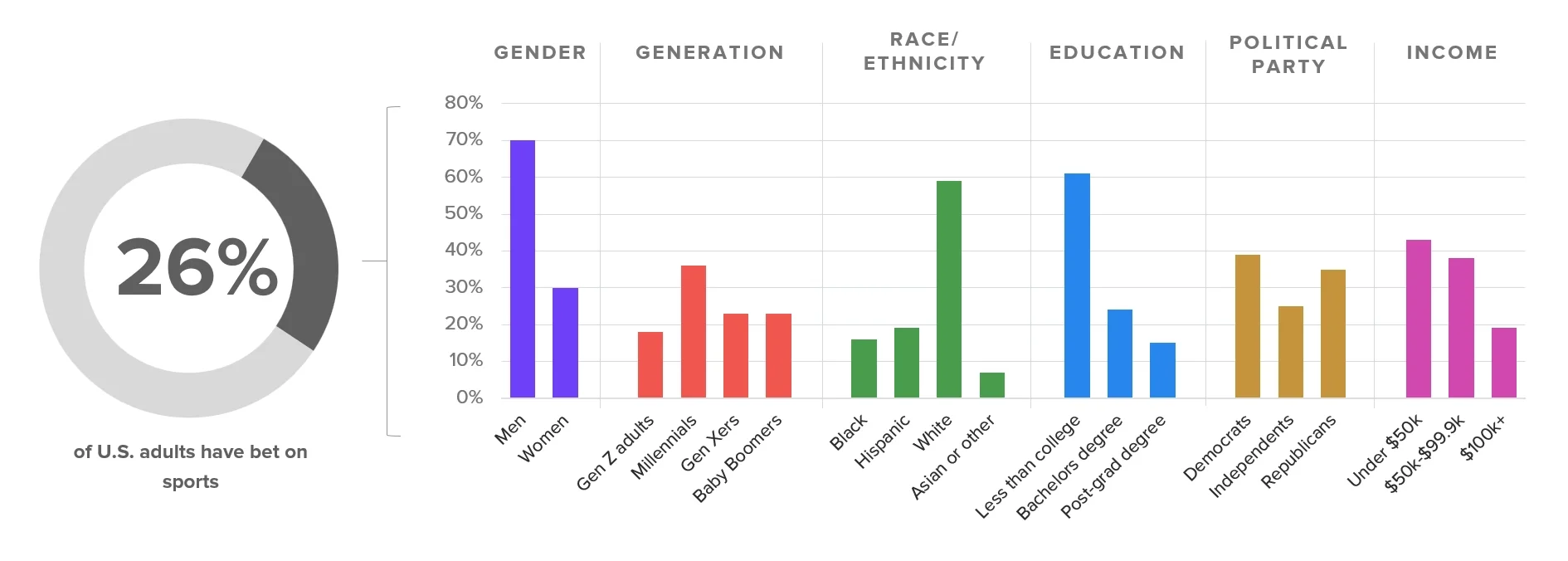
Bettors tend to come specifically from White, male, and low-income demographics (Morning Consult Pro, 2025). However, minority groups are also more likely to bet than their share of the total population would suggest. A 2025 Pew Research Center survey found that 30% of African Americans and 27% of Hispanic Americans have placed a bet in some capacity in the last 12 months (Gramlich, 2025). Therefore, despite a large number of bettors being White, sports gambling seems to be especially popular among younger men of all ethnicities (Gramlich, 2025).
These trends clearly show that large amounts of money are flowing from a narrow slice of the population (young men) to an even narrower slice of the population such as sportsbook owners. As seen in Figure 1, these young men seem to be predominantly from low or modest income backgrounds, raising questions about the economic impacts of sports betting on a financially vulnerable demographic (Morning Consult Pro, 2025).
Economic Impacts on Bettors
Economically, sports betting is a losing game. Studies show that, due to the industry’s high profitability, the typical sports bettor has negative expected returns (Baker et al., 2024). That lost money ends up going into the pockets of sportsbook owners instead.
The scale of these losses is enormous. As of February 2026, there has been a lifetime gross revenue of more than $50 billion for sports betting operators from a $600 billion pool of wagers (Ramsey, 2026). These figures clearly show that tens of billions of dollars have flowed out of the pockets of bettors directly into the hands of betting companies.
This flow of money has been detrimental to consumers beyond the value of their bets. Research shows that the legalization of online sports betting has concentrated effects on financially constrained households, such as increased credit card debt, decreased available credit, and increased overdraft frequency (Baker et al., 2024). Specifically, an 8% increase in credit card debt relative to the sample mean was noted in constrained households, suggesting that sports betting exacerbates the financial constraints of a household (Baker et al., 2024).
The Social Effects: Wealth Transfer
Data clearly suggest that sports betting often hurts the average consumer and shifts money from bettors into the hands of sportsbooks. Additionally, sportsbooks advertise heavily to “men aged 21-34, with heavy advertising on platforms easily visible…TV, sports venues, billboards and radio” (Goldstein, 2026). Given that this target demographic is young and often has limited wealth, the whole industry should be questioned for preying on vulnerable groups.
The main issue with sports betting is not that it is affecting younger men, but because this demographic does not have a financial cushion. One study shows that “young men in low-income counties seem to experience higher bankruptcy rates” since the legalization of sports betting (Hollenbeck et al., 2024). Suggestive evidence shows that these young men then resort to using consolidation loans due to this increase in bankruptcy (Hollenbeck et al., 2024). The visible effect is that sports betting functions as a transfer of wealth from the poor and vulnerable to corporations.
Conclusion
The legalization of sports betting in 2018 has led to unprecedented interest in the world of gambling, especially from young Americans. Studies show that a large fraction of those under 30, especially men, participate in sports betting (Morning Consult Pro, 2025). This accessibility raises important economic questions. Current evidence suggests that widespread sports betting extracts wealth from bettors and channels it into corporate profits, essentially a “wealth transfer” (Hollenbeck et al., 2024).
As the United States continues to move forward under these new sports betting laws, policymakers and communities need to weigh the social costs of sports gambling. Current data suggest these costs, mainly bankruptcies and financial strain on young adults, are concentrated on vulnerable populations. While a full return to a federal ban on sports betting may not be popular, these social costs should not be ignored. Policymakers could mitigate such harm by limiting aggressive advertising to young audiences, adding spending caps, and properly disclosing risk, for example. As sportsbetting will likely continue to grow, the true challenge the U.S. faces is not whether or not Americans should be able to place bets, but rather who ends up paying the price.
References
Baker, S., Balthrop, J., Johnson, M., Kotter, J., & Pisciotta, K. (2024, November). NBER working paper series Gambling Away Stability. NBER Working Paper Series. https://www.nber.org/system/files/working_papers/w33108/w33108.pdf
Five Years Post-PASPA: Consumer sports betting trends - american gaming association. American Gaming Association. (2023, May 9). https://www.americangaming.org/resources/five-years-post-paspa-consumer-sports-betting-trends/
Goldstein, E. (2026, February 5). Study: Thousands of kids are betting on Sportsbook apps. Gambling Insider. https://www.gamblinginsider.com/news/109301/study-thousands-of-kids-are-betting-on-sportsbook-apps
Gramlich, J. (2025, October 2). Americans increasingly see Legal Sports Betting as a bad thing for society and sports. Pew Research Center. https://www.pewresearch.org/short-reads/2025/10/02/americans-increasingly-see-legal-sports-betting-as-a-bad-thing-for-society-and-sports
Hollenbeck, B., Larsen, P., & Proserpio, D. (2024, October). The financial consequences of legalized sports gambling. https://www.lrl.mn.gov/archive/minutes/senate/2025/fin/20250108/Fin_20250108_The-Financial-Consequences-of-Legalized-Sports-Betting.pdf
How Americans feel about sports betting. Morning Consult Pro. (2025, March 10). https://pro.morningconsult.com/analysis/despite-widespread-legality-public-opinion-on-sports-betting-is-still-mixed
Islam, S. (2019, December 10). Men watching flat screen monitors [Photograph]. Unsplash.
Morning Consult. (2025). Figure 1. Demographic profile of sports bettors [Graph]. Morning Consult Pro. https://pro.morningconsult.com/analysis/despite-widespread-legality-public-opinion-on-sports-betting-is-still-mixed.
Ramsey, E. (2026, February 5). US sports betting revenue & handle. Legal Sports Report. https://www.legalsportsreport.com/sports-betting-states/revenue